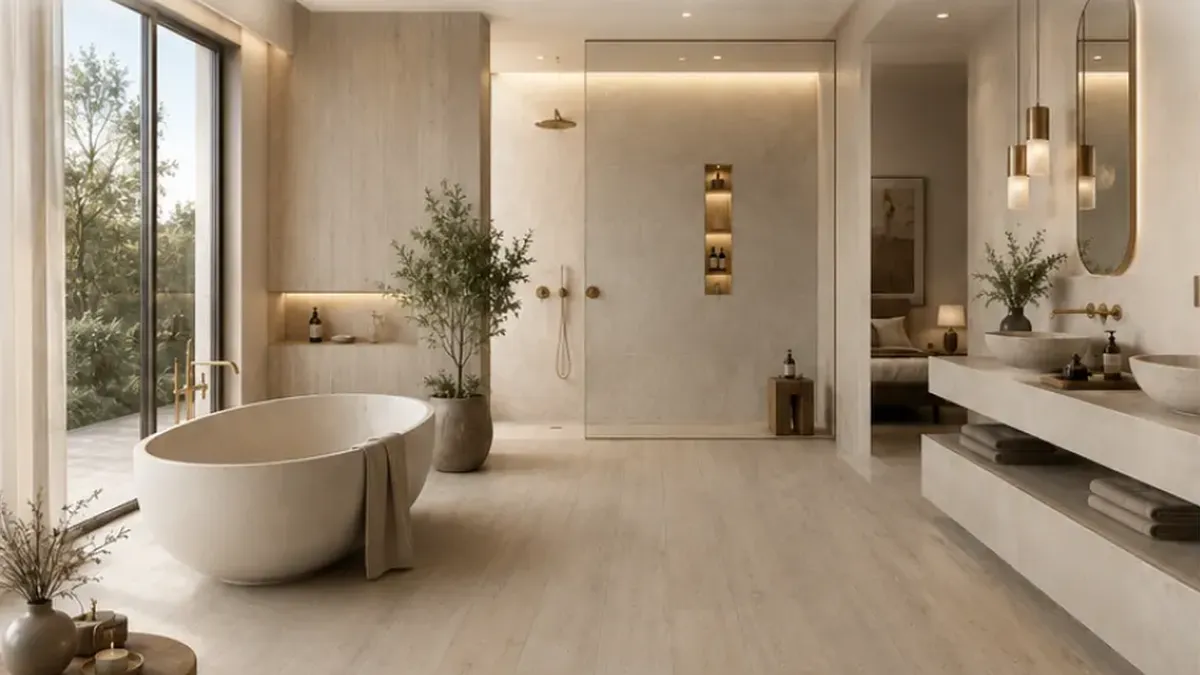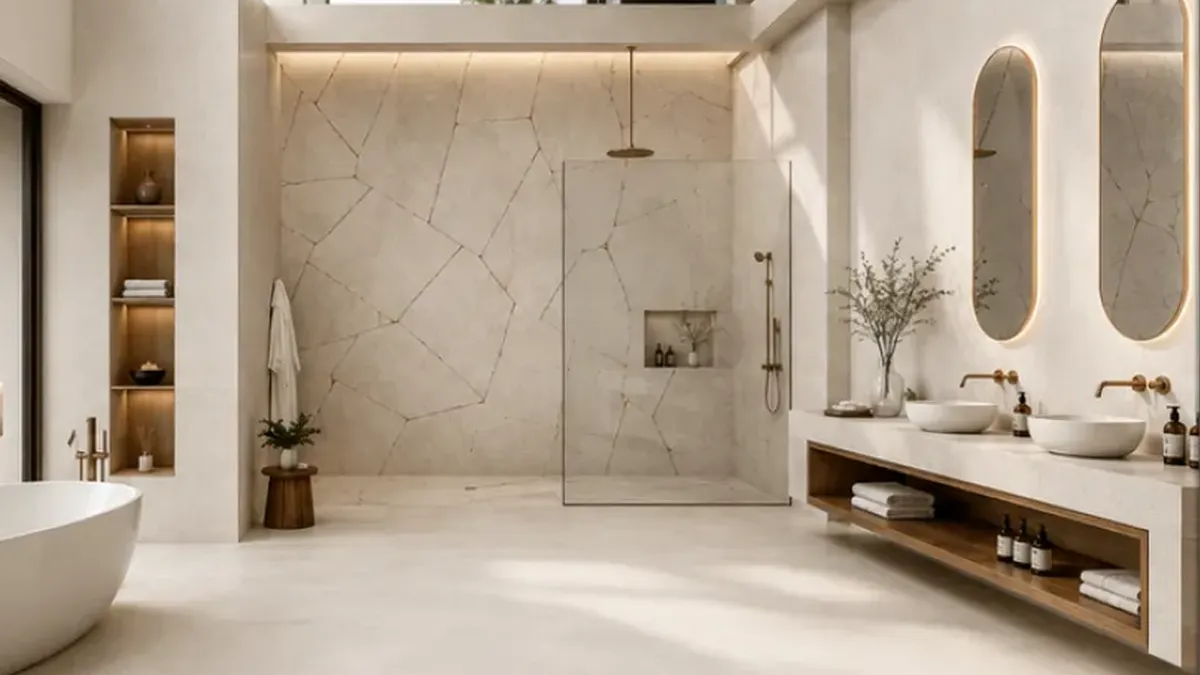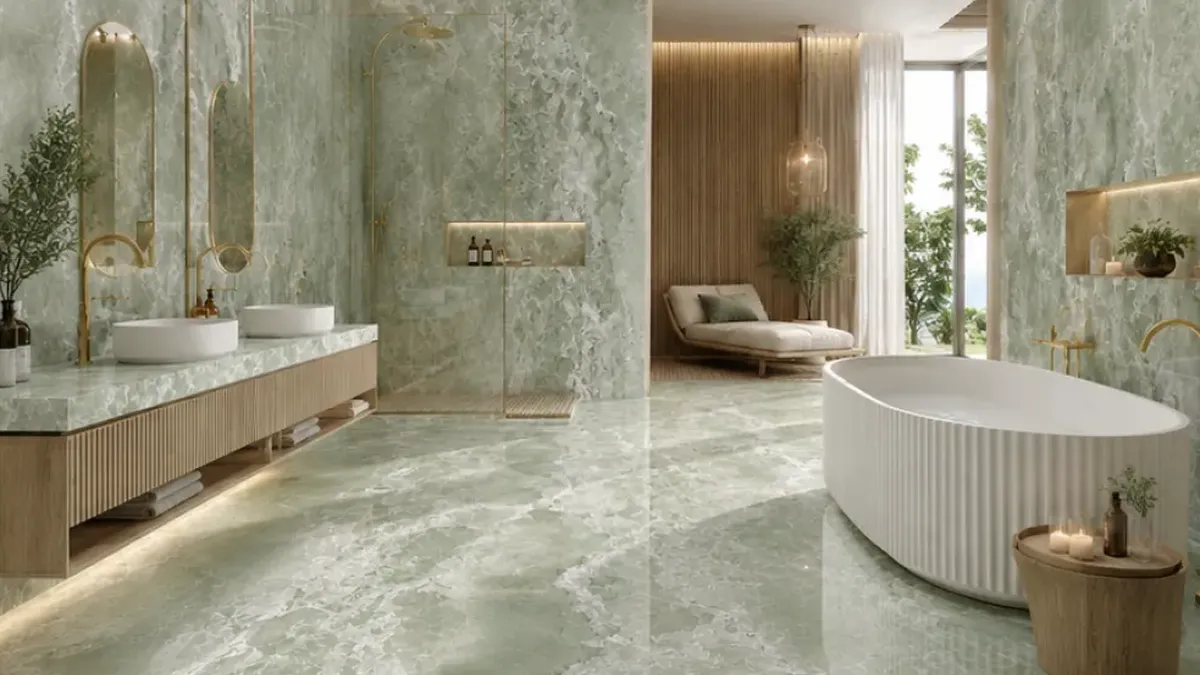
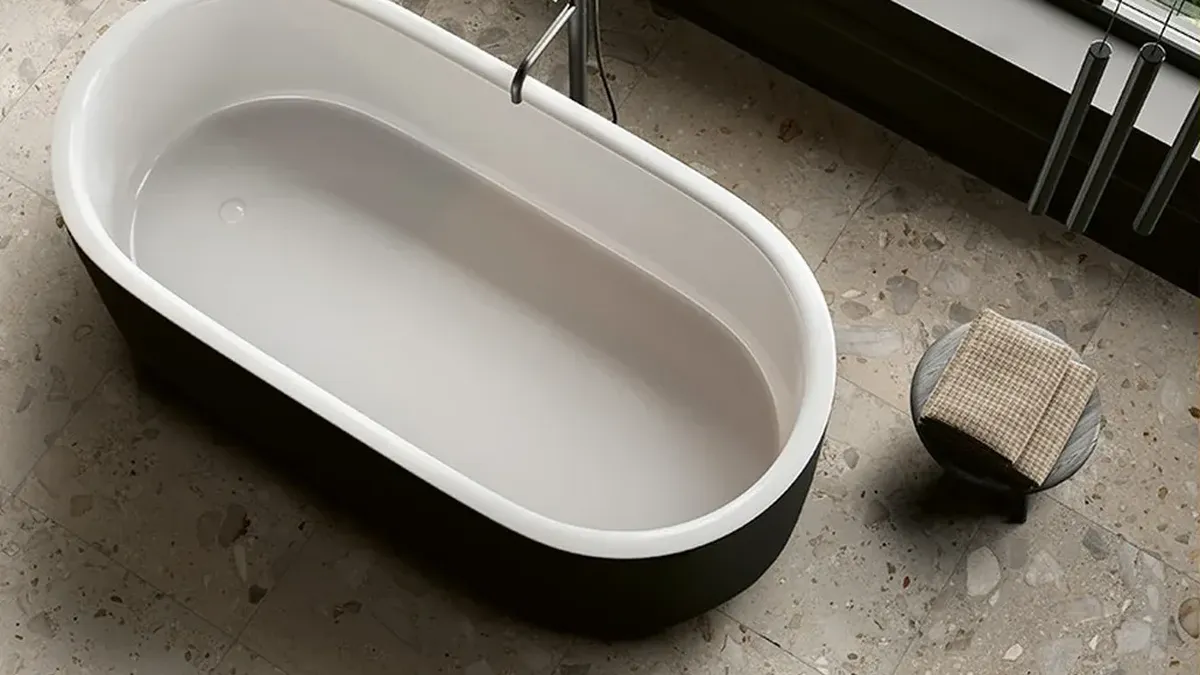
Our view: the bathroom trends most likely to last beyond 2027 are the calm, material-led ones: travertine and limestone looks, concrete looks with the softness of microcement, and very large formats. Coloured checkerboards, wall-to-wall green and fluted tiled walls will date first, because they put fashion on the surfaces that are hardest to change.
In this guide 6 sections
You are planning a bathroom you expect to keep for ten years or more, and most trend lists are written for people who redecorate every spring. Tiles are the wrong place to follow them. A luxury bathroom in the UK typically costs between £25,000 and £60,000 in 2026, according to our luxury bathroom cost guide, and the tiled floor and walls are the parts you would pay most to undo.
So each look below gets a verdict and the reason behind it. The verdicts are our view as a tile and bathroom design studio, not a forecast, and where a look plays to our own specialism we say so.
If you came here for 2026, the looks that filled this year's trend coverage were warm stone and spa-like calm, microcement-style surfaces, large formats, handmade-looking zellige, pattern underfoot and green. The question for 2027 is which of them deserve a floor you will stand on for a decade. For the principles that keep any bathroom right for that long, rather than this year's looks, see bathroom design ideas that last.
Eight looks, with our verdict on each
| Look | UK search term | Monthly searches, Aug 2025 to Aug 2026 | Our view |
|---|---|---|---|
| Travertine and limestone looks | travertine tiles | 3,600 (no change) | Lasting |
| The microcement look | microcement bathroom | 4,400 to 6,600 (up 50%) | Lasting, in concrete-look porcelain |
| Very large formats | 1200x1200 tiles | 260 to 480 (up 85%) | Lasting |
| Zellige-style tiles | zellige tiles | 5,400 to 6,600 (up 22%) | Lasting, in one place |
| Encaustic and patterned floors | encaustic tiles | 1,900 to 2,400 (up 26%) | Lasting in a period house, a fad as a default |
| Checkerboard floors | checkerboard floor tiles | 390 to 480 (up 23%) | Classic in black and white, dated in colour |
| Green tiles | green bathroom tiles | 9,900 to 8,100 (down 18%) | A fad as a whole-room tile colour |
| Fluted tiles | fluted tiles | 1,000 to 1,000 (flat) | A fad on tiled walls |
About the numbers: they are Google Ads estimates of UK monthly searches for the exact terms shown, taken via DataForSEO, comparing August 2025 with August 2026. They are a third-party estimate of interest, not of sales, and one month against another is a rough signal. They show what people are looking at and say nothing about what will age well, which is why the flattest line in the table, travertine, gets one of our firmest verdicts.
The looks we expect to last
Travertine and limestone looks
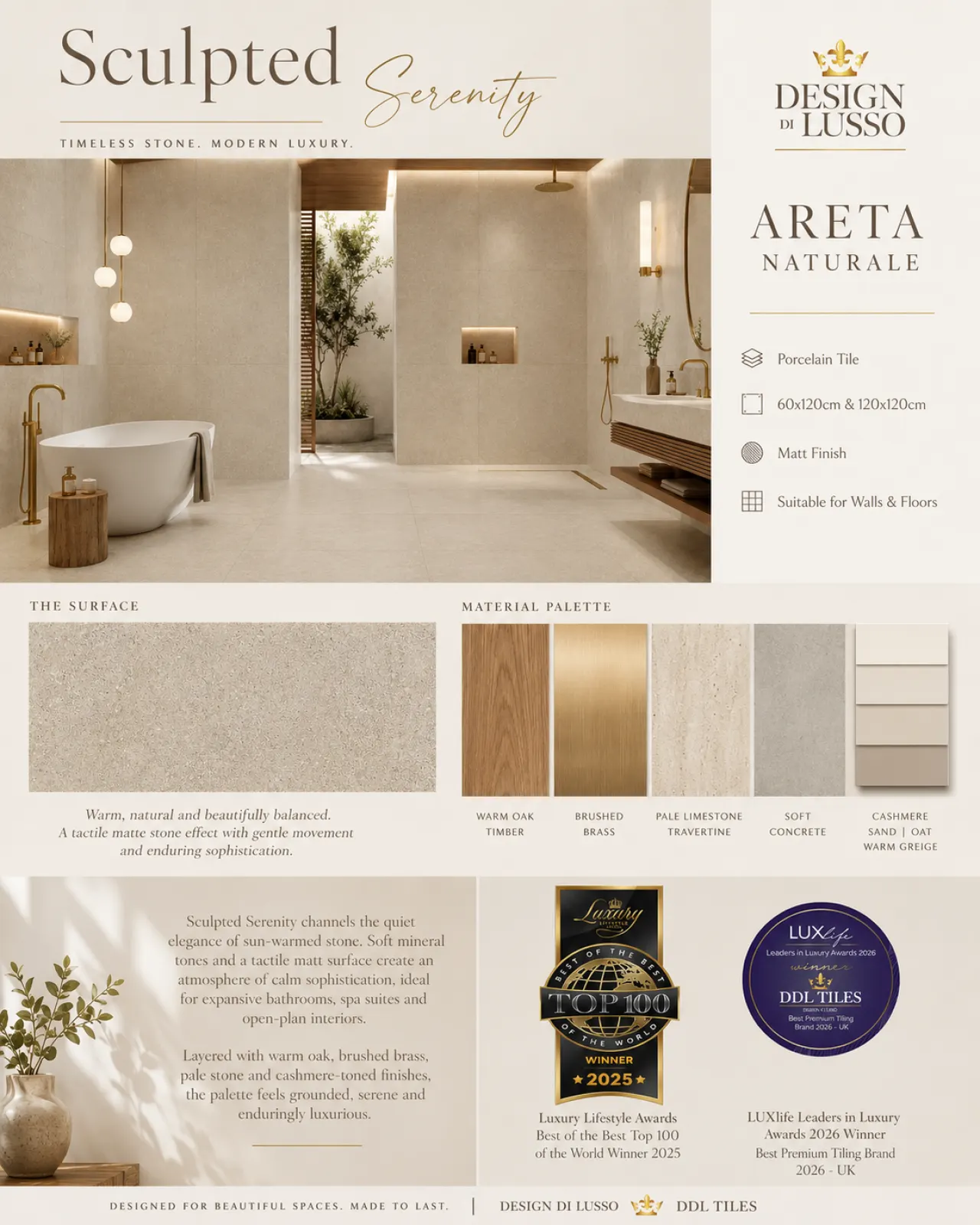
Lasting, in our view. Sand, oatmeal, honey and soft taupe, set against timber and brushed metal, are replacing the cool grey and white bathroom, and the result is still minimal but feels warm at seven on a February morning. Travertine and limestone sit at the centre of it. Both have been used in fine buildings since Roman times, which is about as good a predictor of staying power as design has.
In porcelain you get the look without the sealing that real travertine, with its open pores, asks for. The risk is flatness: a room where every surface is the same beige. Build contrast through texture instead, with a honed floor beside a softly veined wall, a timber vanity or a darker stone shelf. Stone looks are one of the families we hold, so this is a look you can judge at full size rather than on a screen.
The microcement look, in concrete-look porcelain
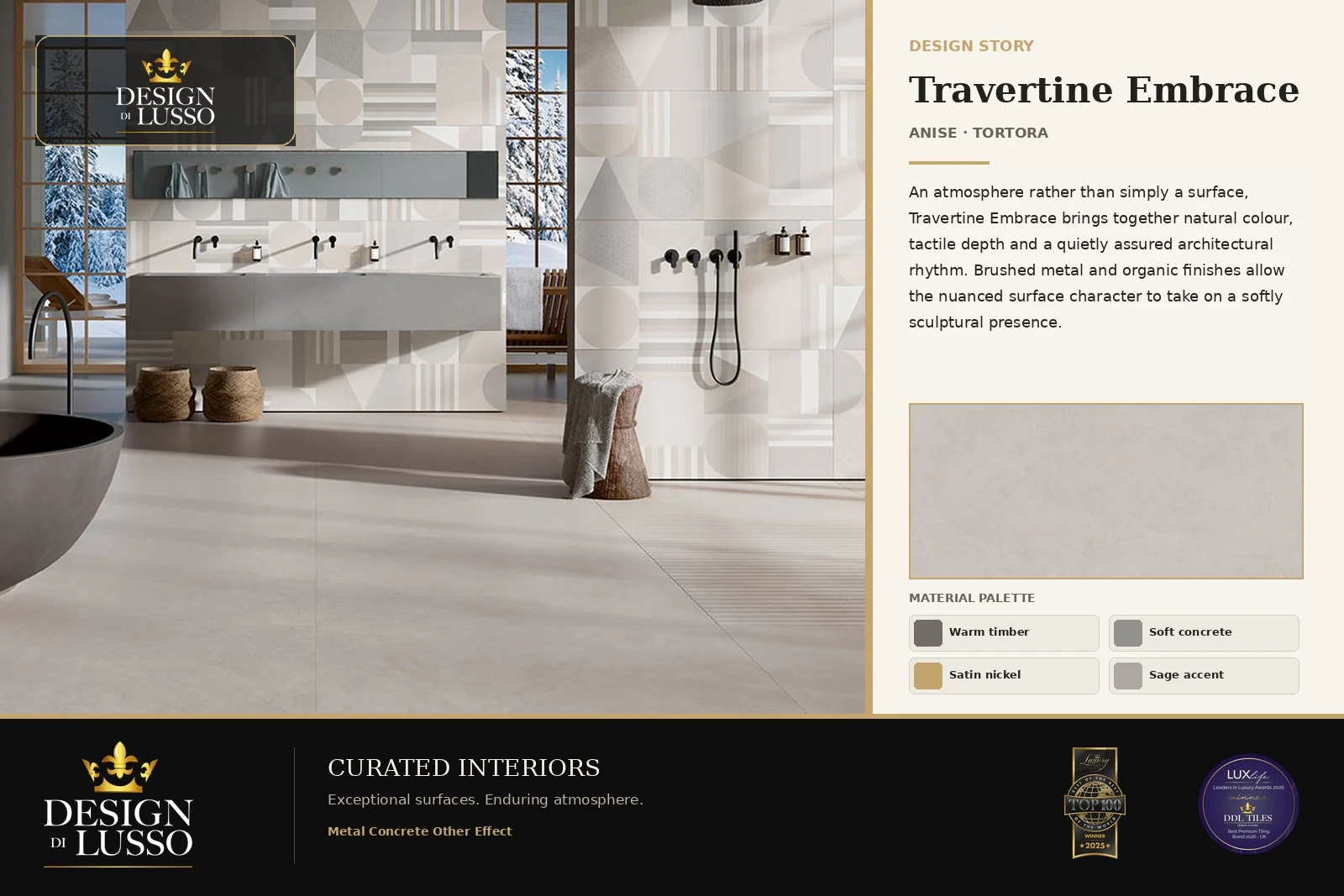
Our view: lasting, and we would do it in porcelain. Searches for microcement bathrooms rose by half in a year, and the appeal is easy to see: a soft, plaster-like surface running across floor and walls, so the room reads as one calm space.
DDL supplies porcelain tiles; we do not sell microcement. Real microcement has genuine strengths: no joints, a thin build that can go over many existing surfaces, and a hand-trowelled softness porcelain can only imitate. It also relies on its sealer, can mark, and can show hairline cracks if the structure beneath it moves, so in a shower its success rests on the applicator. A large concrete-look porcelain gives a similar quiet surface with few grout lines and nothing to reseal. Concrete looks are part of our range, and our microcement vs porcelain comparison sets out where each one wins.
Very large formats
We think large formats will last. Searches for 1200x1200 tiles nearly doubled, the sharpest rise in the table. Large format is our specialism, so weigh our view accordingly; the case for it is practical, not stylistic. Fewer joints make a room calmer and easier to clean, in a small bathroom as much as a large one, and that benefit does not go out of fashion.
What does date a large-format bathroom is poor setting-out. A 1200mm tile bridges every dip in the floor, so floors usually need to be flat to within about 3mm over 2 metres, and in a small room a badly placed starting line leaves slivers at the door and the bath that no tile can hide. We hold large formats from 600x600mm up to 1200x1200mm, and our page on large format porcelain tiles shows where each size works.
Zellige-style tiles
Our view: lasting, in one place. The look comes from handmade Moroccan tiles, whose uneven glaze catches the light differently on every piece. On one surface, such as a shower niche, the wall behind a basin or a small cloakroom, it brings a life a flat tile cannot, and the gloss helps a room with little daylight. Across every wall in a strong colour, it becomes the thing that dates the room.
Where to see these looks before you commit
A trend photographed for a magazine has been lit for the camera. Your bathroom has a north-facing window, or none at all, and the only honest test is the tile itself, at full size, in real light, next to the brassware and timber you plan to use.
That is how we work. Our look book groups directions by mood (calm, dramatic, earthy, luminous, sculptural and warm), and each board is a starting point to refine with the real materials. The showroom holds porcelain in marble, stone, wood, onyx and concrete looks, from 600x600mm to 1200x1200mm, sourced from selected Spanish and Italian factories rather than limited to conventional stock. Visits are by appointment only, so the specialist you meet has set the time aside for your room.
Book a complimentary showroom appointment and bring the square metres for each area, a few photographs of the room and any paint, metal or wood samples the tiles must sit with. You will see the stone, concrete and large-format looks above at full size, and the quotation is prepared from the quantities you bring once your selection is confirmed.
The looks we expect to date
The common thread is fashion on a fixed surface. Pattern and colour can last when the house or the room gives them a reason; as a default, they rarely do.
Encaustic and patterned floors
Our view: lasting in the right house, a fad as a default. In a Victorian or Edwardian house, a geometric floor in the hall or cloakroom continues a tradition the house was built with. As the default floor in a glass-walled extension, a busy pattern dictates every other choice in the room for years.
Traditional encaustic cement tiles are also porous and need sealing, which porcelain versions avoid. If you love pattern, put it on one plane and keep everything around it quiet.
Checkerboard floors
Classic in black and white, dated in colour: that is our view. A black-and-white marble-look checkerboard in a period hall or cloakroom has a long history behind it and will keep it. It can be set out from two marble-look tiles, a family we can show you at full size. The soft two-tone versions in pastel, sage or caramel are the ones most likely to read as early 2020s within a few years.
Green as a whole-room tile colour
Our view: a fad on every wall, lasting in the right dose. Green has had a long run in trend coverage, and it is the one look in the table where UK searches fell. Wall-to-wall green tile commits the most permanent surfaces in the room to its most changeable decision.
Green lasts far better when it comes from the material, as in a green-veined marble or onyx look, or when one surface carries it and paint, timber and brass do the rest. Our guide to green bathroom ideas shows how to use it so it lasts.
Fluted tiled walls
On tiled walls, we would call fluting a fad. Fluted vanities, fluted glass and fluted wall tiles have been everywhere, even though searches for fluted tiles stayed flat over the year. On a vanity front or a single joinery panel, fluting adds depth and leaves with the furniture when you change it. On shower walls, every ridge collects limescale and soap, and in a hard-water area that cleaning starts in the first week.
How to borrow a trend without dating the room
Put the lasting ideas on the fixed surfaces and the fashionable ones on the things you can change.
- Keep the floor and main walls in a stone, limestone or concrete look; a colour of the year belongs on paint.
- Spend the trend on one small area, such as a zellige-style niche or a patterned cloakroom floor.
- Carry fluting, colour and novelty metal finishes in furniture, glass and lighting, which change in a day rather than with a retile.
Whatever the look, choose the floor finish for grip rather than for the photograph. A wet, barefoot floor needs slip resistance in any year, and the HSE treats a pendulum test value (PTV) of 36 or above as low slip potential (HSE GEIS2).
Our view, in short
Follow the calm trends and borrow the loud ones. Travertine and limestone looks, concrete looks in place of microcement, and very large formats will still look right in ten years, because they come from real materials and make rooms easier to live with. Zellige and patterned floors last when they are used in one place, for a reason. Coloured checkerboards, wall-to-wall green and fluted tiled walls will date first.
To see the lasting looks at full size before you choose, book a complimentary showroom appointment in Watford. If you want the whole room designed around them, the bathroom design service is the next step at £400 + VAT per bathroom, deducted from your subsequent order when that order exceeds £5,000 + VAT. The design usually takes around two to four weeks, depending on the project's complexity.
Sources
- Google Ads search volume estimates for the UK via DataForSEO, August 2025 and August 2026. A third-party estimate of search interest, not a measure of sales.
- HSE GEIS2: Assessing the slip resistance of flooring (PTV 36 and above means low slip potential).