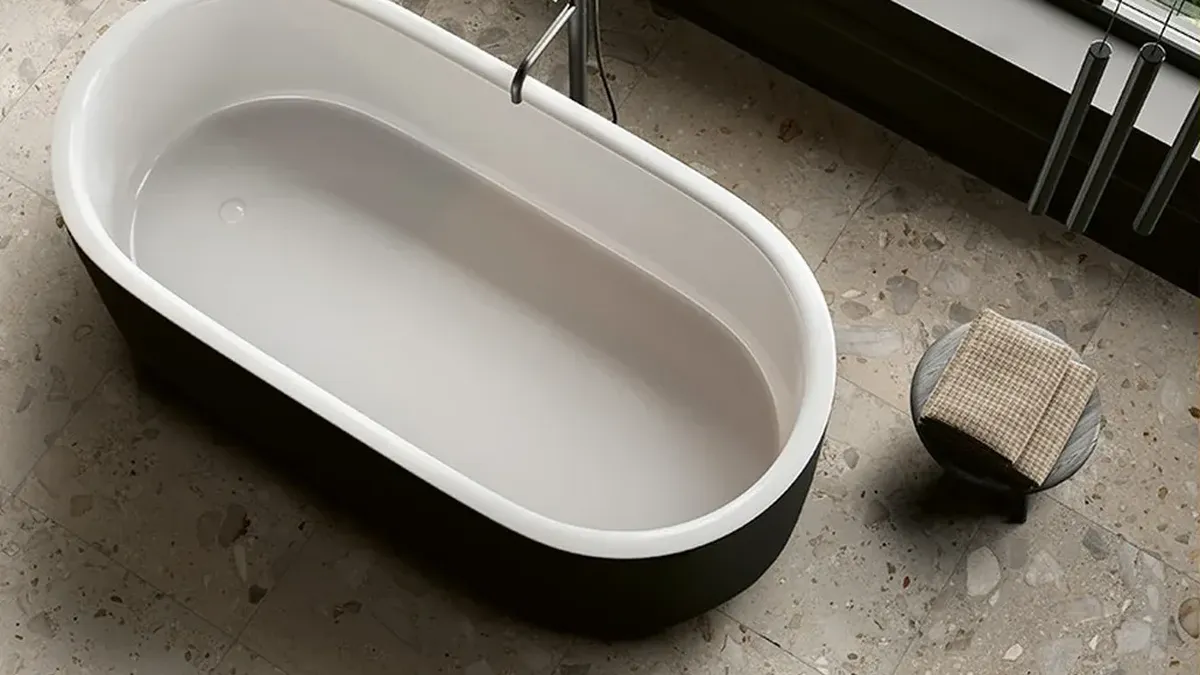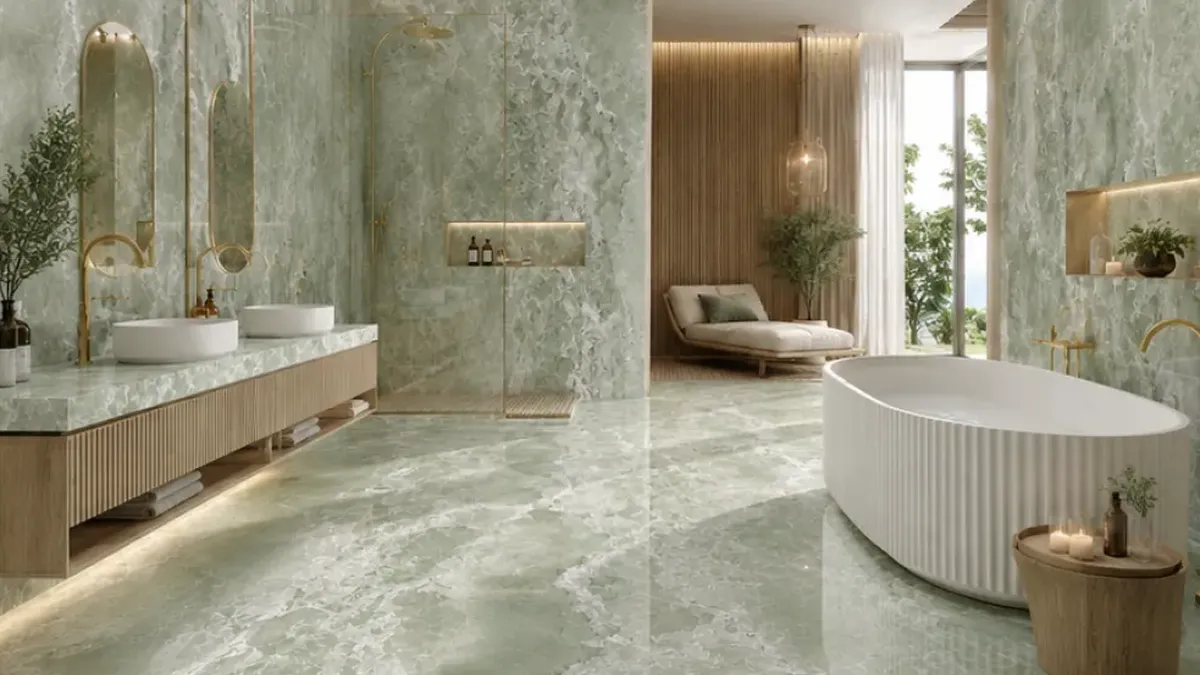

Microcement suits a sculptural bathroom on a solid, stable floor that is used gently, because its water resistance comes from a sealer that has to be renewed. Large-format porcelain is the safer floor and shower finish for a busy family bathroom or an upstairs timber floor, at the price of a few planned joints.
In this guide 10 sections
- Eight points that decide how each one ages
- Is microcement good for a bathroom?
- Cracks, and why the building has the last word
- What the Stanmore master en-suite drawing shows
- Grip and falls on a shower floor
- How long does microcement last in a shower?
- Is microcement cheaper than tiling?
- The closest tile to microcement
- When microcement is the better choice
- Our recommendation
The photograph that starts this decision is usually the same one: floor, walls, bath and basin that seem to be cut from one soft mineral surface, with not a grout line in sight. The question that follows is a practical one. Will it still look like that after five years of a family shower every morning?
Sometimes it will. Quite often, a large-format porcelain floor and shower, with a trowelled finish kept for the one curved wall that needs it, gets you closer to that photograph for longer.
Our interest, declared: DDL supplies porcelain tiles. We do not sell microcement, so read our view knowing which side of the counter we stand on.
Eight points that decide how each one ages
Criteria first, verdict second. Porcelain comes out ahead on water, sealing, cracking and repair. Microcement wins on joints and on anything curved or built in. Both suit underfloor heating, and the look is your call.
| Criterion | Microcement | Large-format porcelain |
|---|---|---|
| Joints | None across the surface | A few fine lines, placed on the drawing |
| Water | Kept out by the sealer | The fired body takes in almost none |
| Sealing | Sealer renewed at intervals | Glazed tile needs none; cement grout may |
| Movement in the base | Shows as a crack | Tolerated over a stiff, uncoupled base |
| Repair | Patches rarely match | One tile cut out and replaced |
| Underfloor heating | Works, in the maker's sequence | Works very well |
| Shower floor grip | Relies on an anti-slip top coat | A tested matt or textured finish |
| Look | Hand-made, cloudy, one of a kind | Predictable, in many looks |
| Best for | Curved, built-in rooms on a slab | Family bathrooms, showers, timber floors |
Most of that table comes down to where each surface is made. Microcement is made in your room: a cement-based coating with polymers and pigment, trowelled by hand in several thin coats over a primer and often a reinforcing mesh, then finished with a multi-coat sealer. The whole layer is a few millimetres thick. What you get depends on who holds the trowel, and on the temperature and humidity while each coat cures.
Porcelain is pressed and fired at very high temperature, which leaves it dense and hard. Under BS EN 14411 it sits in group BIa, so it absorbs 0.5% water or less. Good large formats are rectified, ground to exact size after firing, which is what allows very fine joints.
The real difference is what you sign off. With porcelain, the tile you choose is the tile that arrives. With microcement, you approve a sample board and trust one person to reproduce it across every wall, on every day of the job.
Is microcement good for a bathroom?
Yes, in the right room. Its downsides are the three things a thin coating cannot escape: it needs looking after, it reports any movement underneath it, and it is hard to repair invisibly.
The sealer is the part you maintain. Most systems want a pH-neutral cleaner and a fresh sealer coat at intervals the manufacturer sets. Limescale removers and abrasive pads wear it faster, which matters in a hard-water area, where the temptation is always to scrub.
Light shows the hand. A window or wall washer that rakes across the surface picks out every trowel stroke. Some owners love that.
Mould is less of a worry than people expect. With no grout lines, microcement removes the place mould most often starts in a tiled shower, although mould feeds on soap film and anything that stays damp, whatever it is made of. Where the sealer has worn through, water can get into the cement itself and leave dark patches that do not wipe away. Approved Document F sets the ventilation requirements where building work is done, and your installer or building control will know whether it touches your project.
Neither finish is waterproofing on its own. Ask a microcement applicator which membrane goes under the wet zones and whether it belongs to the same manufacturer's system; with porcelain, tanking goes beneath the tile in every shower.
Cracks, and why the building has the last word
Microcement is the more likely of the two to crack, because a continuous coating a few millimetres thick has nowhere to hide movement. Porcelain is more forgiving, provided the floor beneath it is flat, stiff and uncoupled.
Upstairs floors in older houses are often suspended timber, and a floor that gives slightly underfoot is a poor base for a rigid coating. Most manufacturers will want it stiffened and overboarded first, and even then the risk stays higher than on a concrete slab. Under large tiles, an uncoupling membrane takes up small movements before they reach the tile, and planned movement joints give the rest somewhere to go.
Jointless describes the surface, never the building. Where an extension meets the original house, the structural movement joint still has to come up through the microcement. Leave it out and the building makes its own joint, in the form of a crack.
Repairs separate them further. A cracked tile can be cut out and replaced, which is why a few spares from the same batch belong in the loft, whereas a microcement patch has to match the colour and trowel texture of a surface that has aged for years. Sometimes the only honest fix is to recoat the whole wall.
What the Stanmore master en-suite drawing shows
The master en-suite in our Stanmore design has a freestanding bath set into a lit recess, a ledge behind it and a curve overhead. Our design keeps it in tile, and the elevation shows how.
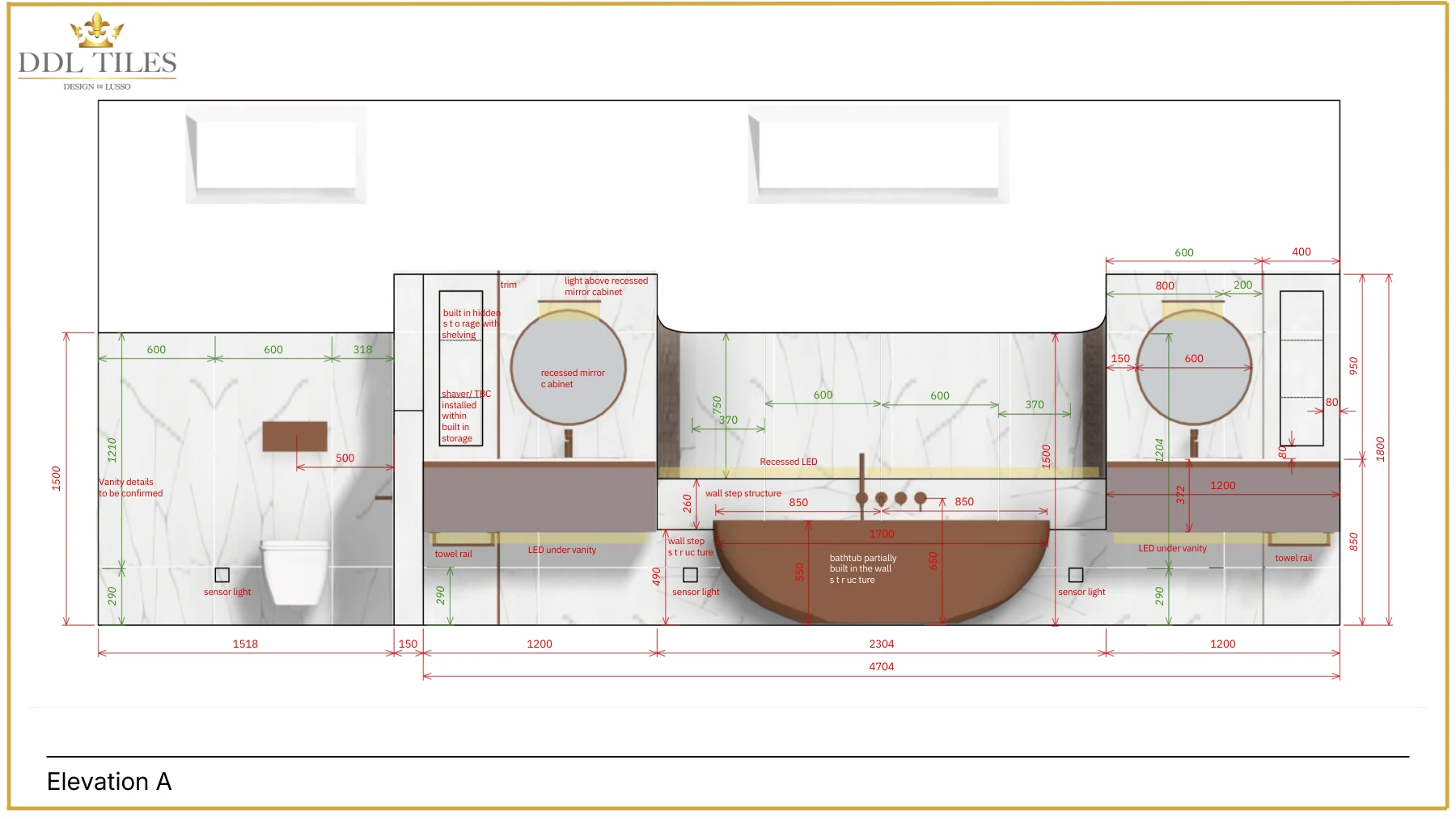
Look at the recess. The tile inside it is set out as two full 600mm pieces with a 370mm piece at each end, so the cuts are equal either side of the bath mixer and the eye never lands on a sliver. The bath sits partly within the wall structure, below a step with recessed LED running along it.
Then the curve. On the drawing, and in the 3D visual of the same room, the tile stops at a straight line and the arched head of the recess is left as a smooth, untiled surface. That is the hybrid this post recommends: tile where water and hands go, a soft finish on the curve where they do not.
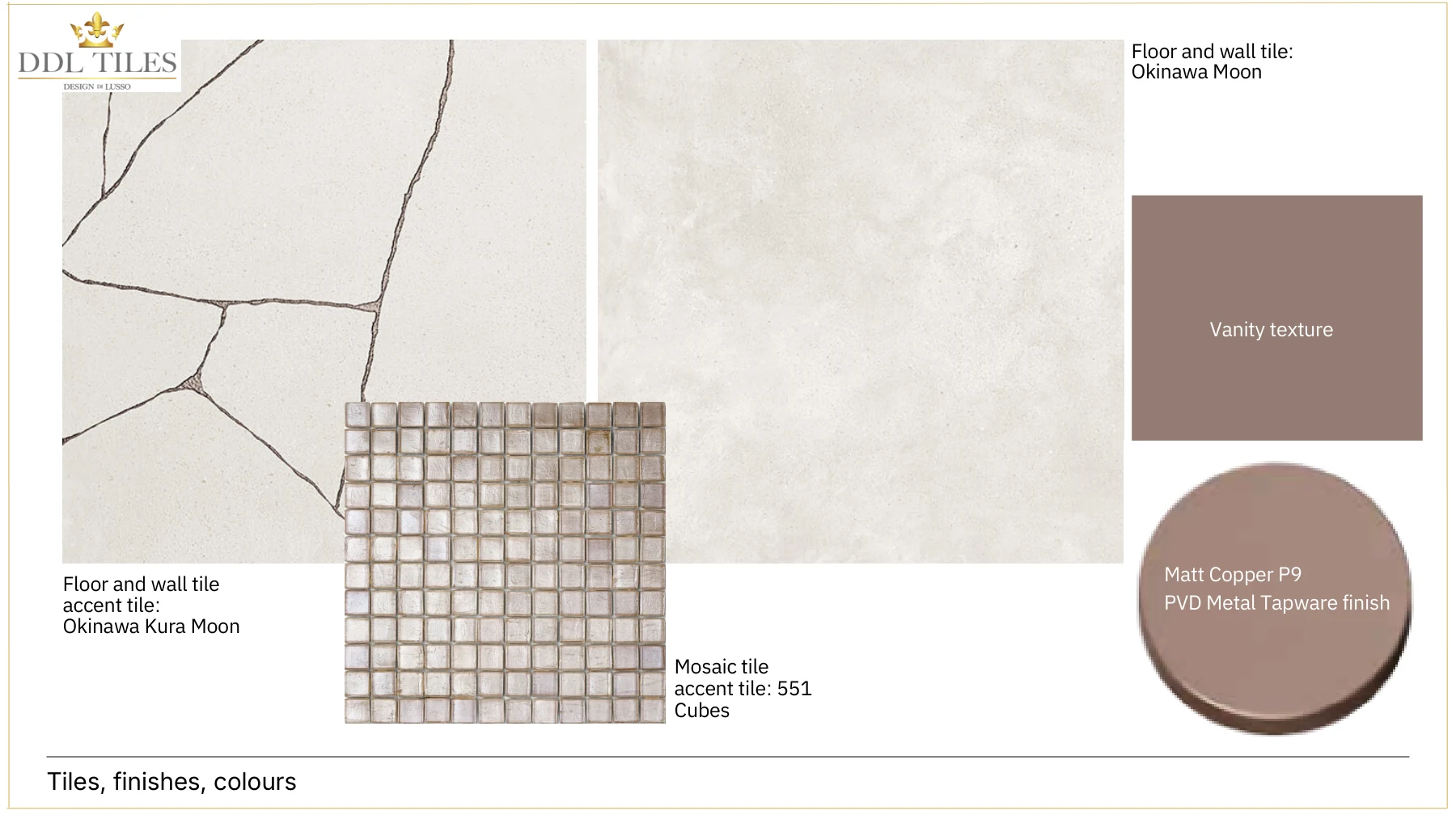
The finishes page names the materials. Okinawa Moon, a calm off-white with soft clouding, covers the floor and walls, and Okinawa Kura Moon, the same base with a kintsugi-style crack pattern, is the accent. Our Okinawa Moon look book board lists both as matt porcelain in 60x120cm for walls and floors. That clouded base is about as close as a fired tile gets to the movement of microcement, and it can run into a shower without depending on a sealer.
To judge that clouding against a real microcement sample, book a complimentary showroom appointment in Watford. A specialist will lay out matt concrete and stone looks at full scale, including 1200x1200mm pieces, under real light. Bring the square metres of floor and wall, and a photo of the microcement bathroom you keep coming back to.
Grip and falls on a shower floor
Porcelain is easier to specify safely here, because you can choose a finish with a published wet slip result that does not wear away. Microcement's grip comes from an anti-slip additive in its top coats, and it wears with the sealer.
For any bathroom floor, ask for the pendulum test value measured wet. HSE guidance counts a wet PTV of 36 and above as low slip potential (HSE GEIS2). R ratings are quoted too, but they come from a ramp test in safety shoes on an oiled surface (DIN 51130), which says little about a bare foot on soapy water.
Falls are where microcement has a genuine edge. A centre drain makes the floor fall from four sides, so large rigid tiles have to be cut into envelope shapes to follow it, while a trowelled coating simply follows the slope. Specify a linear drain against one wall and the floor falls in a single plane, with large tiles running straight to it.
How long does microcement last in a shower?
No single number is honest. The coating can last as long as the room if the base never moves; what wears is the sealer, and how quickly depends on the system, the cleaning and how often the shower runs.
A guest shower used at weekends and a family shower used twice a day are different propositions. The floor and the wall under the head go first, then the bath edge and the basin surround.
So treat the resealing interval as the number to get in writing before you commit, together with the cleaning products the warranty allows and who carries out the reseal. If an applicator will not commit to an interval on paper, that tells you something.
The porcelain surface, by contrast, does not wear through. Grout is the part that may need refreshing over the years, and epoxy grout needs very little.
Is microcement cheaper than tiling?
Not reliably, and the comparison is easy to get wrong. Microcement is mostly skilled labour, several coats over several days, plus primer, mesh, sealer and any anti-slip finish. Porcelain costs the tile, the preparation and an experienced installer.
We do not sell microcement, so we will not guess at an applicator's price for a shower. For the tile side, our luxury bathroom cost guide puts premium porcelain, marble-effect and stone-effect ranges at typically £60 to £200+ per m² supply-only. Waterproofing/tanking typically adds £600 to £2,500+, and that applies whichever finish goes on top.
Ask both trades for itemised quotes so that like is compared with like:
| The quote should show | Microcement | Porcelain |
|---|---|---|
| Preparation | Stiffening, overboarding, primer | Levelling, overboarding, uncoupling membrane |
| Waterproofing | The named membrane under wet zones | Tanking under the shower and splash zones |
| The finish | Number of coats, mesh, sealer coats | Tile, adhesive and grout specification |
| Shower floor | Anti-slip top coat and its wet test result | Tested finish and drain type |
| Aftercare | First reseal, and the interval in writing | Spare tiles from the same batch |
One saving can favour microcement. Where existing tiles are sound and the system allows it, it can go over them and skip a full strip-out, although a shower that needs a new membrane has to go back to the structure whichever finish follows.
The closest tile to microcement
A matt concrete-look porcelain in a large format. The Emfo looks in our look book mood boards are a good reference: the Emfo Carbone board lists a matt charcoal concrete look in 60x120cm and 120x120cm for walls and floors, and Emfo Lichene shows the same surface in a muted sage.

Beside real microcement, a concrete-look tile is more consistent, which you will either value or miss. What it adds is range: the same calm in a warm limestone or a soft off-white, and marble, stone, onyx and wood looks besides. DDL sources from selected Spanish and Italian factories, and at 1200x1200mm a single tile covers the area of four 600x600mm tiles, so an en-suite floor may need only a handful of joints.
Scale changes how a surface reads, so judge a large format at full size rather than from a swatch. Our complete guide to large format tiles and slabs covers sizes, slabs and handling.
When microcement is the better choice
When the design depends on continuous, curved or built-in surfaces, the structure is stable, and you are happy to look after a living finish. In those rooms, tile would mean dozens of visible cuts.
- A sculptural en-suite with curved walls, a built-in bench, plinths or a wrapped bath.
- No height to spare, where a thin coating can go over a sound existing surface.
- A guest bathroom used a few times a month, where a sealer wears slowly.
- A ground-floor room on a concrete slab, rather than an upstairs room on joists.
You need not pick one for the whole room. Put microcement on the curved walls and a built-in bench, and large-format porcelain on the floor and in the shower, and you get softness where you look and durability where you stand. The junction between the two needs a designed stop or shadow gap, drawn before anyone starts.
If warmth underfoot matters more than a jointless look, our comparison of LVT and porcelain for a bathroom floor covers the softer option, and our bathroom flooring ideas set every floor material side by side.
Our recommendation
For a family bathroom, a shower floor or any room on timber joists, choose large-format porcelain: it absorbs almost no water, the tile needs no sealer, and damage can be repaired one piece at a time. Choose microcement for a sculptural, gently used room on a solid slab, and get the resealing interval in writing first. For many rooms the best answer is both, with tile underfoot and in the shower and a smooth finish on the curves, as the Stanmore drawing shows. DDL designs and specifies; your installer works from the written specification.
The choice is easier with both surfaces in your hands. Book a complimentary showroom appointment with a few pictures of the space as it stands today. If you want the room designed in full, the bathroom design service is £400 + VAT per bathroom, deducted from your subsequent order when that order exceeds £5,000 + VAT. Design usually takes around two to four weeks, so a scheme started now can be drawn up before Christmas.
Sources
- HSE information sheet GEIS2, on floor slip resistance: a wet PTV of 36 or more means low slip potential.
- HM Government, Approved Document F: Ventilation.
- BS EN 14411, the classification standard for ceramic tiles. Porcelain sits in group BIa: water absorption no higher than 0.5%.
- DIN 51130, the ramp test behind R9 to R13 slip ratings.