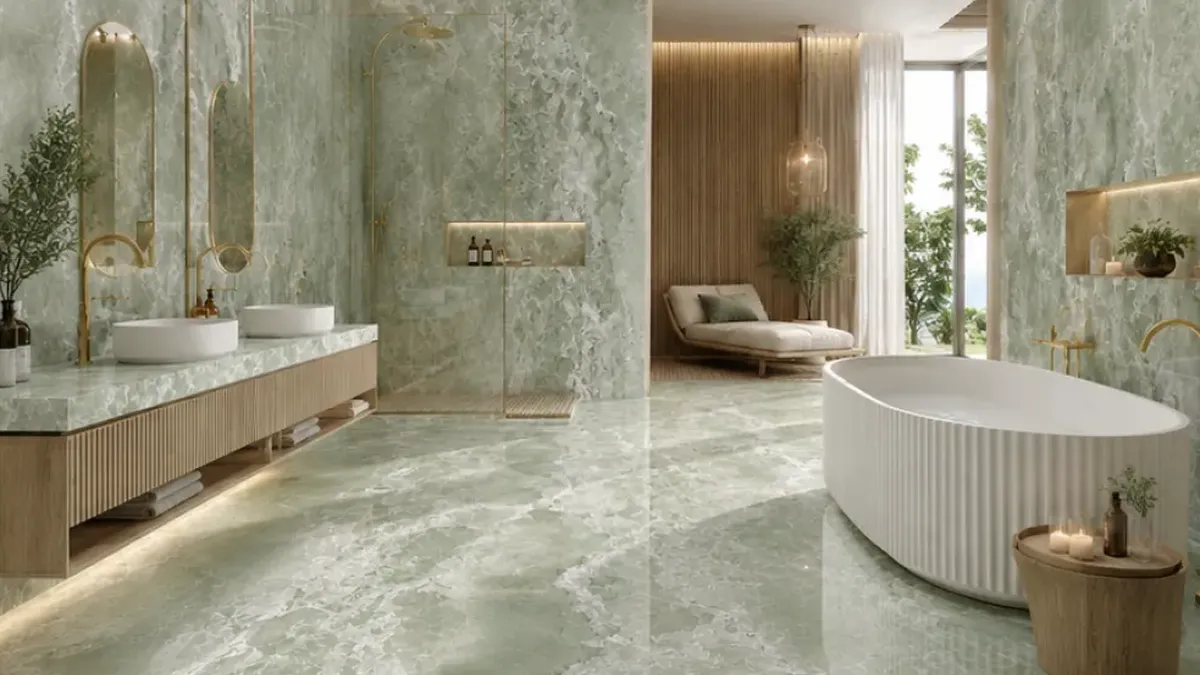
Green works in a bathroom when one surface carries it and everything around it stays quiet. Choose a veined onyx, marble or patinated stone look over a flat glaze, keep polished green to the walls with a matt floor, and partner it with oak or walnut, one warm metal and a soft white.
In this guide 9 sections
- Nine green bathroom ideas that hold back
- Five greens from our look book
- Sage, olive or forest: start with the light
- How much green a room can take
- Floors: where green needs a matt finish
- What green needs around it
- Light changes green more than most colours
- Should the green go on the tiles or the walls?
- Our view
You have saved forty green bathrooms and still cannot commit. The fear is fair: green is the colour most likely to tie a room to the year it was done.
Yet it rarely fails because of the shade. It fails through quantity, when one flat green covers every wall and the floor as well, chrome sits on every fitting and the light is cold, so that the eye has nowhere to rest. Hold it back and green becomes one of the easiest colours to live with.
Nine green bathroom ideas that hold back
- Tile only the bath wall or the shower in green, and keep the rest warm white.
- Pick a veined onyx look over a flat green glaze.
- Pale green onyx on the walls, a matt sage concrete look on the floor.
- Wrap a cloakroom, floor to ceiling, in a deep green marble look.
- Pair the tile with a pale oak or walnut vanity, never a second green that nearly matches.
- Use one warm metal, brushed brass or aged bronze, for every tap, rail and frame.
- Match the grout to the background of the tile, not to its veins.
- Paint green above neutral tile if you are unsure you will love it in five years.
- For an en-suite used mostly in the evening, a dark patinated green with smoked oak and bronze.
Five greens from our look book
Five green ranges feature in our look book mood boards, and between them they cover most of the ways green can go, from a tint inside pale stone to a near-black patina. The sizes and finishes below are the ones each board lists. A board is a design direction rather than a stock list, so ask about each range when you book.
| Range | Look | Board lists | Finish |
|---|---|---|---|
| Precious Green | Translucent pale green onyx | 60x120cm, 120x120cm | Polished |
| Mystic Emerald | Soft sage onyx, cream veins, gold accents | 60x120cm, 120x120cm | Matt and polished |
| Emfo Lichene | Muted sage concrete look | 60x120cm, 120x120cm | Matt |
| Basilica Verde | Deep green marble look, warm veining | 60x120cm | Matt and polished |
| World Green | Dark oxidised green with a patina | 60x120cm, 120x120cm | Matt and polished |
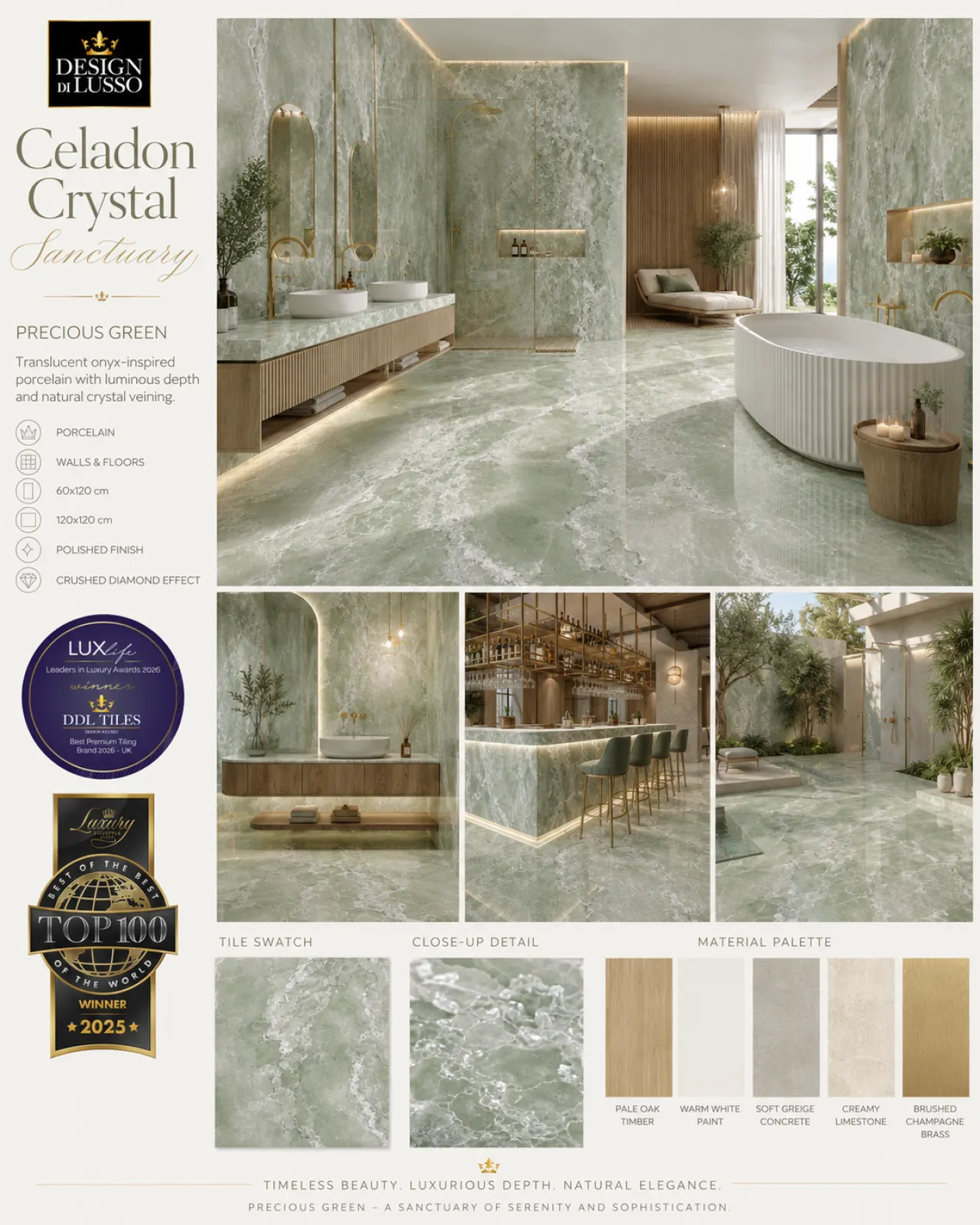
Read the palettes as closely as the tiles. Precious Green sits with pale oak, warm white, soft greige, creamy limestone and brushed champagne brass, and nothing else on its board is green.
World Green, far darker, takes smoked oak, aged bronze, honed limestone and mineral concrete. Its only companion green is a soft olive paint, clearly a different depth from the tile.
One thing on the Precious Green board should not be copied at home. It shows the polished onyx look running across the bathroom floor, which works in a render and is a poor idea for wet bare feet. Keep a polished green to the walls and the bath surround, and put a matt tile underfoot; Mystic Emerald and World Green are both listed in matt as well as polished, so wall and floor can share a colour without sharing a finish.
DDL sources from selected Spanish and Italian factories, and a green chosen from a screen is a gamble. To see these greens against your own finishes, book a complimentary showroom appointment in Watford. Bring the square metres for each wall and floor, a photo of the room in daylight, and your tap finish and vanity timber if they are already chosen.
Sage, olive or forest: start with the light
Choose the depth of green by the light the room gets, then by mood. A swatch that looked right on a phone can behave very differently across a whole wall.
- Sage, green with a lot of grey in it, is the easiest to live with every day. North light can push it towards grey, so look at the sample on an overcast afternoon.
- Olive carries yellow and brown and is happiest with brass and walnut. Under very warm lamps it can turn muddy.
- Forest or bottle green encloses a room. Give it a cloakroom, a dressing area or the end wall behind a bath, not a small dark bathroom used in a rush at 7am.
- Pale green onyx and marble looks sit between colour and neutral, which suits anyone who wants green without committing to a shade.
Garden-facing rooms are green's natural home. When the window frames trees or a lawn, the colour carries the view indoors instead of competing with it, and the room reads calmer and slightly larger. The one combination to avoid is a deep shade on every surface of a windowless family bathroom.
How much green a room can take
Let green own one plane: the walls, the floor or the shower. A second element can echo it quietly, a towel, a painted ceiling or a vanity front in muted olive. Beyond that, the colour starts competing with itself.
Cloakrooms are the exception, because you pass through rather than linger. A deep green marble look such as Basilica Verde can wrap the floor and every wall, with warm metal and concealed light doing the rest, and the brevity of the visit is what makes that much drama comfortable.
Family bathrooms work the other way. Everyone uses them, often in a hurry, so green belongs in the background there: sage walls above neutral tile, or one green wall in the shower with a calm floor.
Two signs a scheme has gone too far. You cannot say which surface is the feature. Or two greens sit side by side and neither looks right, usually because one leans blue and the other yellow; if you want two, keep them far apart in depth, a pale sage with a deep forest.
Floors: where green needs a matt finish
On a bathroom floor, finish matters more than shade. Polished green looks deepest on a wall, but wet bare feet need grip, so choose a matt or textured tile underfoot and ask for its wet pendulum test value: HSE treats 36 or more as low slip potential (HSE GEIS2).
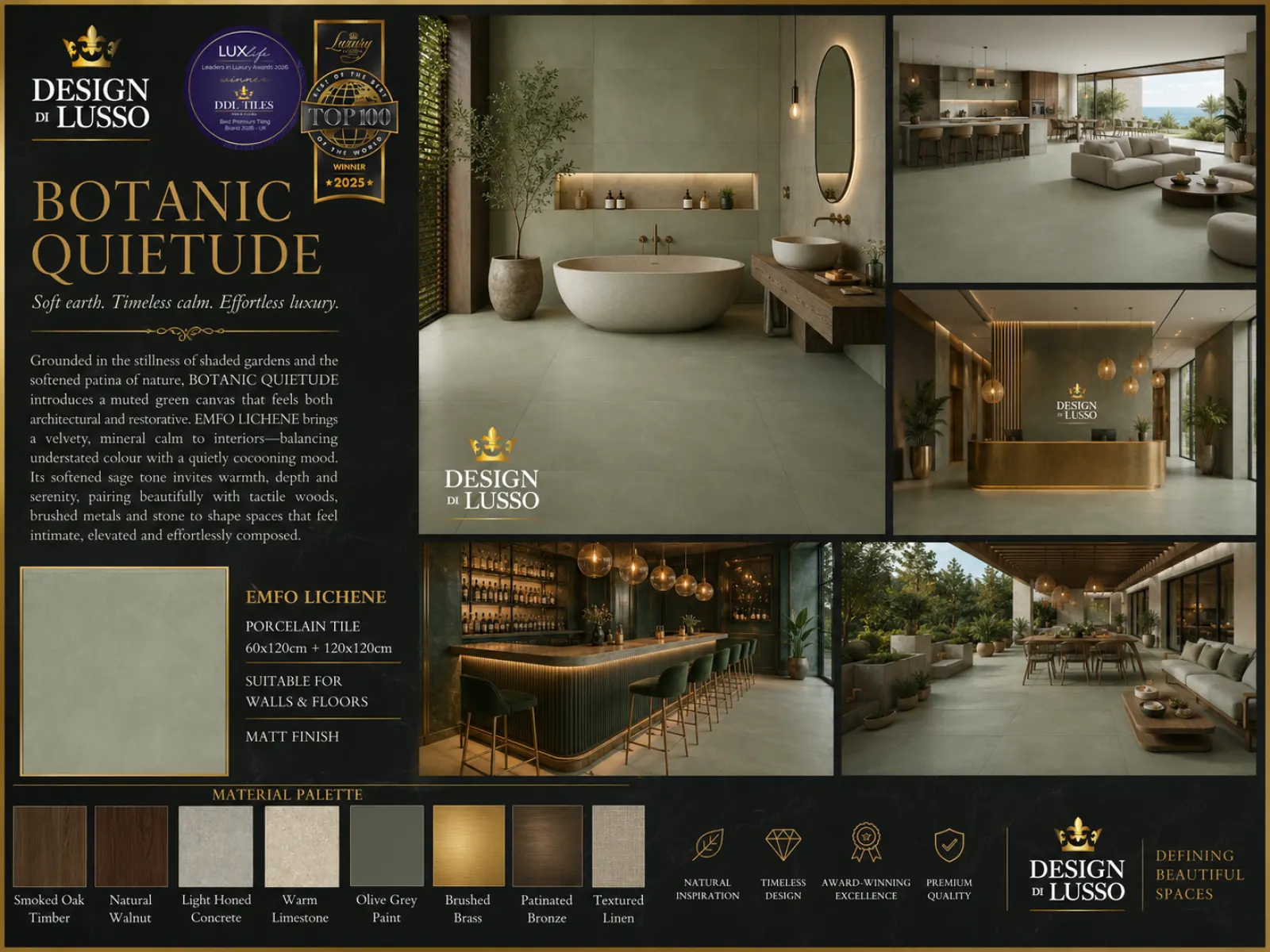
Emfo Lichene is the quietest route. Its board lists it only in matt, and its sage is soft enough to sit under a pale onyx wall without the two greens arguing.
Darker floors need more thought. Deep green shows water marks, limescale and dust more readily than a mid tone, so if you love World Green or Basilica Verde underfoot, take the matt version and accept that a quick wipe after bath time becomes part of the routine.
Grout decides the rest. Match it to the background tone of the tile rather than the veins, because pale grout on dark green draws a grid across the floor. Glazed porcelain needs no sealing; a polished finish is sometimes given a protective coat before grouting, and the maker's instructions will say whether yours is one.
What green needs around it
Warm partners. Look across the green boards and the same three things keep appearing: brass or bronze, mid-tone timber, and a soft white or limestone.
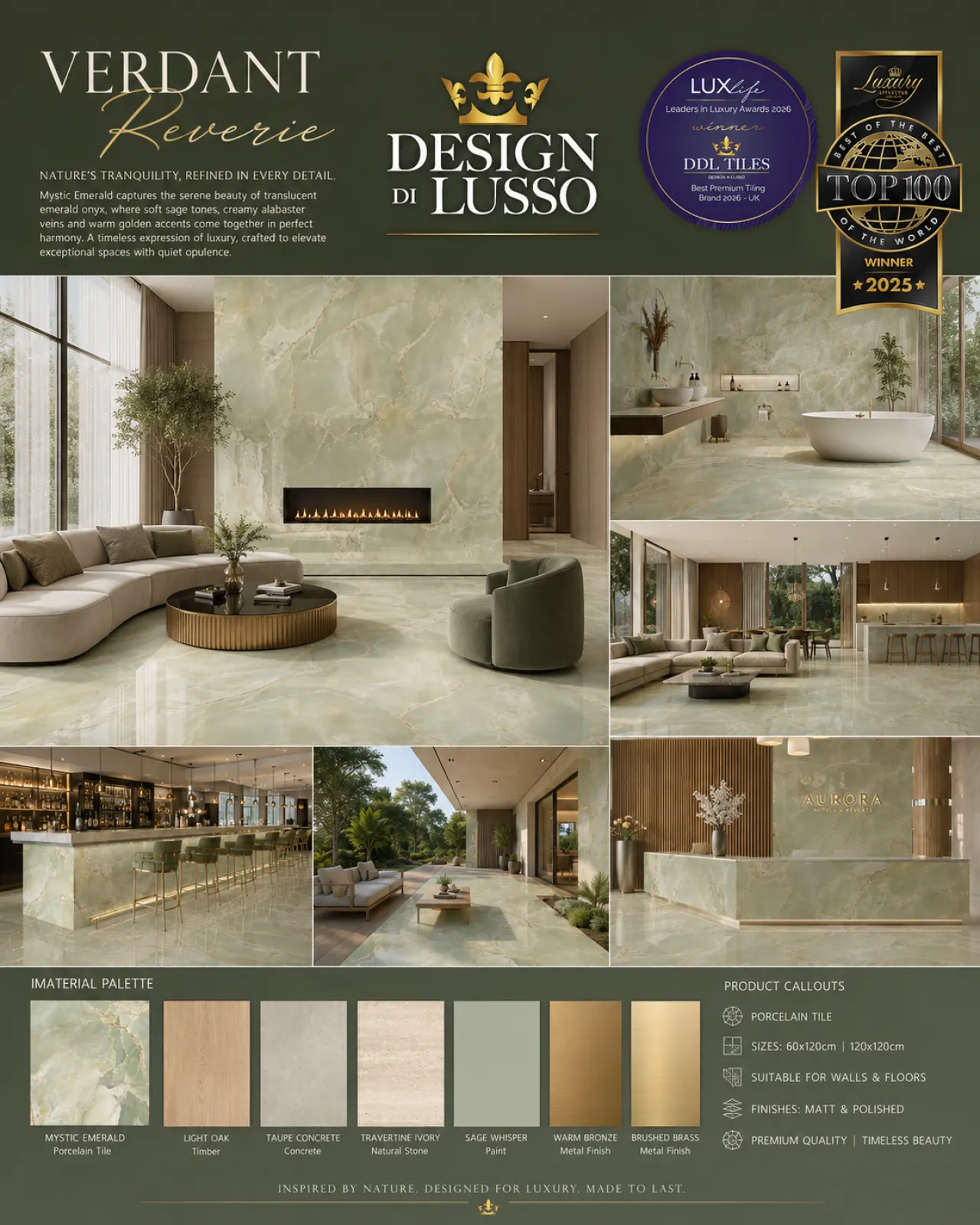
Metal. Brushed or aged brass draws out the yellow in olive and forest greens, and bronze suits the darker patinas. Chrome cools sage and can tip a room towards clinical. Choose one finish and use it for taps, shower, towel rail and mirror frames alike.
Timber. Walnut deepens a forest green scheme; pale oak lightens sage. Since 2024 DDL has offered bespoke Italian vanity units, so the vanity can be made to suit the tile rather than the other way round.
White. Choose a warm white for the basin, bath, WC and ceiling. Brilliant white beside green looks blue and harsh, and because the sanitaryware is the largest white in the room, its tone matters more than people expect.
Light changes green more than most colours
Warm lamps pull green towards yellow and cool ones pull it towards grey. Warm white light tends to suit it, but every tile has its own undertone, and only a sample under your own lamps will tell you how yours behaves. Choose fittings with a CRI (colour rendering index) of at least 90, so the green you chose is the green you see.
Daylight matters just as much. North light is cool and even and flattens green, while a south or west-facing room gets warmer afternoon light that brings it alive, and a window onto trees reflects green back into the room, so the same wall looks different in June and December. Every fitting must suit its bathroom zone under BS 7671, so agree the positions with your electrician.
Before you order, look at the real tile in the real room, at night, under your own lights.
Should the green go on the tiles or the walls?
Tile it when you are sure; paint it when you are not. Both routes can look expensive.
Green tile makes the colour part of the architecture. It takes water and steam in its stride and carries the colour into the shower where paint cannot go, at the price of permanence, because changing a tiled wall means a renovation. Green paint above a warm stone or soft marble-look tile can be changed in a weekend, provided it stays out of the shower and away from the basin splashback.
The middle route is often the best. Tile the shower or the wall behind the bath in green, keep the rest neutral, and the colour reads as a deliberate moment rather than a theme. For layout, lighting and specification beyond colour, our complete guide to luxury bathroom design goes further.
Our view
A green bathroom lasts when the colour has one clear job. Let a single surface carry it, choose a veined onyx, marble or patinated look over flat colour, and put a matt green or a calm neutral underfoot even when the walls are polished. Surround it with oak or walnut, a warm metal and a soft white or pale stone, the partners that recur on every green board in our look book. Then check the real tile under your own lights, because green moves more than almost any other colour between morning and night.
Book a complimentary showroom appointment and see the 120x120cm sizes at full scale in real light, beside your paint cards and timber samples. If you would like the whole room designed, the bathroom design service is £400 + VAT per bathroom, deducted from your subsequent order when that order exceeds £5,000 + VAT. Design usually takes around two to four weeks, so a scheme started now can be drawn up before Christmas.
Sources
- HSE GEIS2, the Health and Safety Executive's note on judging floor slip resistance; a wet pendulum result of 36 or more counts as low slip potential.
- BS EN 14411, Ceramic tiles: definitions, classification and characteristics.
- BS 7671, the IET Wiring Regulations, which define the electrical zones in a bathroom.